
The Best CPUs for Every Workload in 2026: Gaming, Coding, Education, 3D Design, and Workstation Picks
Published on PyroCPU.com — Your source for processor news, reviews, and analysis
Meta Title: Best CPUs for Gaming, Coding, 3D Design & Workstations in 2026 | PyroCPU
Meta Description: Our expert picks for the best processors across gaming, programming, education, 3D rendering, and workstation use in 2026. AMD Ryzen and Intel Core Ultra recommendations with real benchmark data.
Focus Keyword: best CPUs 2026
Secondary Keywords: best gaming CPU, best CPU for coding, best CPU for 3D rendering, workstation processor, best CPU for students, AMD vs Intel 2026
The processor you choose defines what your computer can do and how well it does it. A gamer needs different things from a CPU than a software developer. A 3D artist has different priorities than a student. A workstation user building simulations or crunching datasets operates in a different universe than someone editing documents and browsing the web.
The good news about 2026 is that both AMD and Intel are delivering genuinely excellent processors across every price tier. AMD's Zen 5 Ryzen 9000 series and 3D V-Cache variants are dominating gaming and multi-threaded workloads. Intel's Arrow Lake Core Ultra 200S processors brought NPU integration and improved efficiency to the desktop, and the new Panther Lake mobile chips built on Intel 18A are shaking up the laptop market. Meanwhile, previous-generation Zen 4 and Raptor Lake chips are hitting price points that make them incredible value.
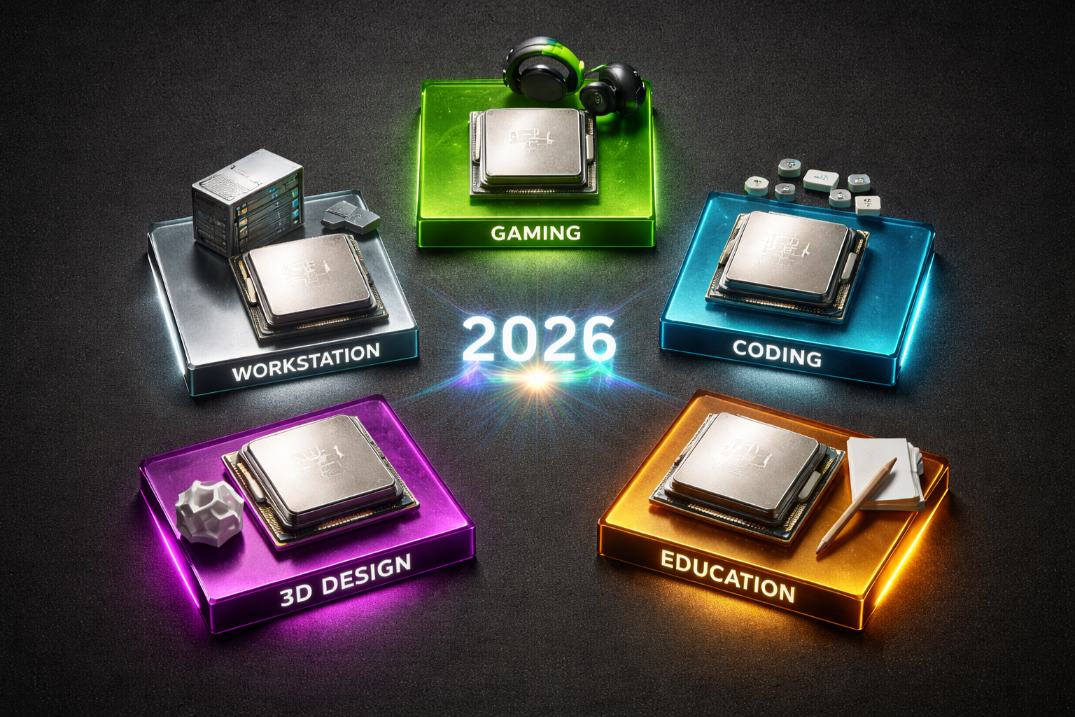
This guide cuts through the noise. We have selected the best processors for five distinct workload categories — gaming, coding, education, 3D design, and workstation — with specific model recommendations, the reasoning behind each pick, and links to real benchmark data on FPSBench.com so you can verify every claim yourself.
For a deeper look at how we cover processor technology here at PyroCPU, check our new CPU technology article.
Best CPUs for Gaming
Gaming is where CPU selection gets interesting. Frame rates depend on a complex interaction between single-threaded performance, cache architecture, memory latency, and how well the processor feeds data to the GPU. Clock speed alone does not tell the story — which is why AMD's 3D V-Cache technology has been so disruptive across three generations now.
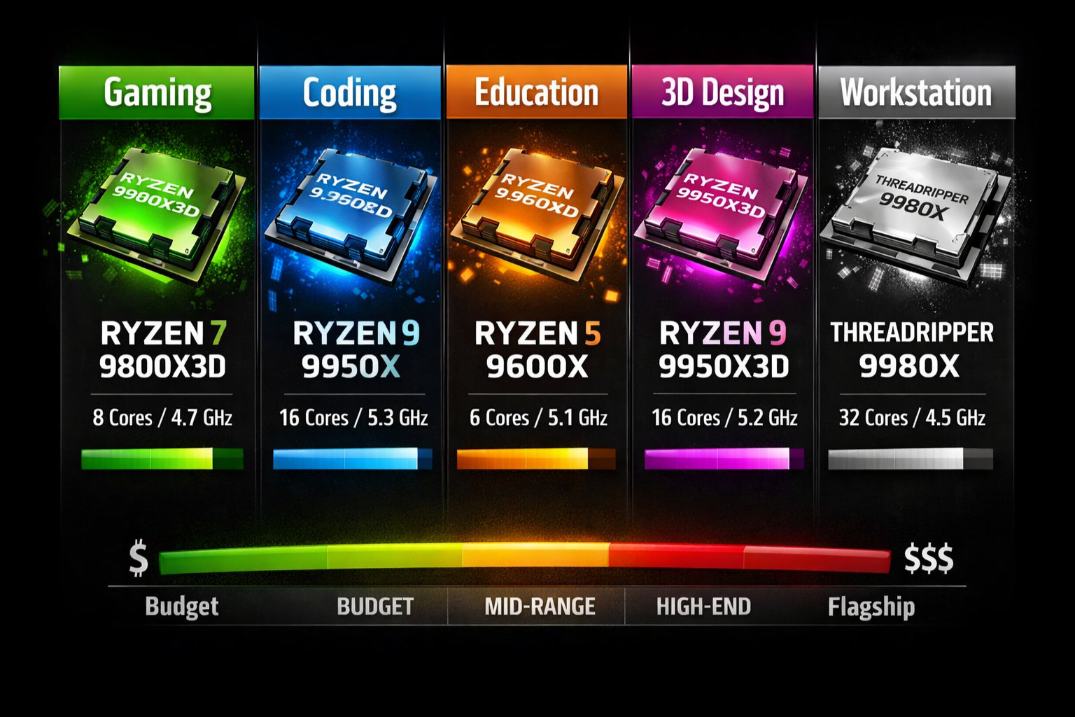
Top Pick: AMD Ryzen 7 9800X3D
The AMD Ryzen 7 9800X3D is the gaming champion of this generation. Eight Zen 5 cores, 16 threads, and 96MB of 3D V-Cache that dramatically reduces memory latency in game engines. According to independent testing, it beats Intel's Core Ultra 9 285K by significant margins in most gaming scenarios.
What makes the 9800X3D special is not raw clock speed. The magic is in the cache. Modern game engines constantly access large data structures — world geometry, AI state, physics objects — and having 96MB of fast L3 cache means far fewer trips to main memory. The performance impact is measurable and significant, particularly at 1080p and 1440p where the CPU is more likely to be the limiting factor.
AMD has also announced the Ryzen 7 9850X3D at CES 2026 with even higher clocks, though it has not yet shipped at the time of writing. The 9800X3D remains the one to buy right now.
Runner-Up: Intel Core Ultra 9 285K
The Intel Core Ultra 9 285K is Arrow Lake's flagship desktop processor, launched in late 2024. With 8 performance cores and 16 efficiency cores (24 total), it delivers strong frame rates and edges ahead of AMD in certain titles that favor Intel's architectural strengths. Where the 285K really shines is in mixed workloads — gaming while streaming, gaming while running background applications. The hybrid core design handles parallel tasks without impacting game performance.
Budget Gaming: AMD Ryzen 5 9600X
The AMD Ryzen 5 9600X proves you do not need to spend flagship money for smooth gaming. Six Zen 5 cores deliver excellent single-threaded performance, and at 1440p and 4K — where the GPU becomes the bottleneck — the 9600X performs within a few percent of processors costing twice as much. For budget builders, the even cheaper Ryzen 5 9600 (non-X) offers nearly identical gaming performance at a lower price.
Verify these gaming CPUs against each other using the CPU comparison tool on FPSBench. We also maintain a computer hardware section here on PyroCPU with regular updates.
Best CPUs for Coding and Software Development
Software development workloads are surprisingly diverse. Compiling a large C++ codebase is a heavily multi-threaded task. Running a local Kubernetes cluster with multiple containers demands both core count and memory bandwidth. But the moment-to-moment experience of writing code — IDE responsiveness, build times for incremental changes, running unit tests — depends heavily on single-threaded performance.
Top Pick: AMD Ryzen 9 9950X
The AMD Ryzen 9 9950X is the developer's dream processor. Sixteen Zen 5 cores and 32 threads provide massive parallel compilation throughput, while the architecture's strong IPC ensures that single-threaded tasks like IDE indexing and linting remain snappy. Docker and container-heavy workflows run comfortably with cores to spare.
Runner-Up: Intel Core Ultra 7 265K
The Intel Core Ultra 7 265K offers a compelling alternative for developers. Its hybrid architecture with 8 performance cores and 12 efficiency cores handles compilation and container workloads efficiently, and the integrated NPU provides hardware acceleration for local AI coding assistants — an increasingly common tool in modern development workflows.
Budget Development: AMD Ryzen 7 9700X
The AMD Ryzen 7 9700X hits the sweet spot for developers who do not need 16 cores but want more than six. Eight Zen 5 cores handle most development workloads comfortably. The lower price compared to the 9950X makes it the practical choice for most professional developers. The Ryzen 7 9700F variant drops the integrated graphics for an even lower price if you are using a discrete GPU anyway.
Compare these development-focused CPUs side by side on FPSBench's comparison page. For our detailed analysis of how to get the most from your hardware, see our performance optimization guide on PyroCPU.
Best CPUs for Education
Students need processors that handle their academic workload reliably without breaking the budget. The specific requirements vary by level — a high school student running Google Docs and Zoom has different needs than a graduate student running MATLAB simulations — but value and longevity are universal priorities.
Top Pick for University Students: AMD Ryzen 5 9600X
The AMD Ryzen 5 9600X is the ideal university processor. Six Zen 5 cores handle everything from research papers and statistical analysis to light programming coursework and after-hours gaming. The reasonable price leaves budget for other components, and the AM5 platform ensures upgrade headroom for years.
Top Pick for Graduate Research: AMD Ryzen 9 9900X
The AMD Ryzen 9 9900X serves graduate students and researchers who need more processing power for data analysis, simulation work, or AI-related coursework. Twelve Zen 5 cores and 24 threads manage heavy multitasking and computational workloads without slowdowns, at a price point below the 16-core 9950X.
Budget Education Pick: Intel Core Ultra 5 245K
The Intel Core Ultra 5 245K provides solid performance for students at every level. Its efficiency cores keep power consumption manageable, while the performance cores handle demanding tasks when needed. The integrated NPU future-proofs the system for AI-powered educational tools that are rapidly becoming mainstream. For even tighter budgets, the Ryzen 5 9500F delivers strong performance at a lower cost.
Use the CPU price-performance rankings on FPSBench to find the best value at your budget level. We also have a dedicated computer hardware infographic on PyroCPU that visualizes how components work together.
Best CPUs for 3D Design and Rendering
3D design workloads are split between two very different performance profiles. Interactive viewport work in applications like Blender, Maya, Cinema 4D, and 3ds Max depends on single-threaded performance and GPU acceleration. Final rendering — whether CPU-based (Cycles CPU, V-Ray CPU, Arnold) or GPU-based — demands maximum multi-threaded throughput. The ideal 3D design processor excels at both.
Top Pick: AMD Ryzen 9 9950X3D
The AMD Ryzen 9 9950X3D is the ultimate hybrid for 3D artists. Sixteen Zen 5 cores with second-generation 3D V-Cache deliver both the multi-threaded rendering throughput of the 9950X and the cache-enhanced responsiveness that benefits interactive viewport work. For artists who render overnight and model during the day, this processor handles both phases without compromise.
Runner-Up: AMD Ryzen 9 9950X
The AMD Ryzen 9 9950X remains the go-to if the 9950X3D's premium is hard to justify. Sixteen cores and 32 threads tear through CPU-based renders in Blender Cycles, V-Ray, and Arnold. The Zen 5 architecture's strong IPC keeps viewport manipulation smooth even in complex scenes with millions of polygons.
Mid-Range 3D: AMD Ryzen 7 9700X
The AMD Ryzen 7 9700X offers strong 3D performance for artists who primarily use GPU rendering (Cycles GPU, Octane, Redshift) and need a capable CPU mainly for viewport work and scene management. Eight fast Zen 5 cores handle interactive 3D work beautifully, and the lower price frees up budget for a more powerful GPU — which is often the smarter investment for GPU-rendered workflows.
Check how these processors compare in multi-threaded benchmarks on the FPSBench CPU rankings page. For our in-depth look at CPU rendering and cooling considerations, visit our water cooling safety guide on PyroCPU — essential reading for anyone pushing a high-core-count chip to its limits.
Best CPUs for Workstation and Professional Use
Workstation processors serve professionals running demanding applications — finite element analysis, computational fluid dynamics, scientific simulation, large-scale data processing, virtualization, and enterprise software development. These workloads demand sustained multi-threaded performance, massive I/O bandwidth, and rock-solid stability.
Top Pick: AMD Ryzen Threadripper 9980X
The AMD Ryzen Threadripper 9980X delivers 64 Zen 5 cores of workstation-class processing power. For professionals running ANSYS simulations, compiling massive codebases, managing virtualized environments, or processing large datasets, Threadripper eliminates waiting. The platform supports massive memory capacities and extensive PCIe lane counts for multiple GPUs and NVMe drives. For even more cores, the Threadripper PRO 9995WX pushes to 96 cores.
Runner-Up: AMD Ryzen Threadripper 9960X
The AMD Ryzen Threadripper 9960X offers 24 cores at a more accessible price point for professionals whose workloads do not require 64+ cores but need more than a mainstream desktop chip can provide. It hits a practical sweet spot for small studios, freelancers, and engineering firms.
Mainstream Workstation: AMD Ryzen 9 9950X
The AMD Ryzen 9 9950X serves as a capable mainstream workstation processor for professionals whose workloads fit within 16 cores. The AM5 platform's lower cost compared to Threadripper's sTR5 makes it the practical choice for freelancers and small teams who need strong performance without enterprise-level investment.
For workstation buyers evaluating cost versus performance, the CPU price-performance analysis on FPSBench provides the data needed to determine whether stepping up to Threadripper is justified. Our overclocking guide on PyroCPU covers how to squeeze extra performance from workstation chips when every second of render time counts.
The 2024, 2025, and 2026 CPU Landscape: Key Models Worth Tracking
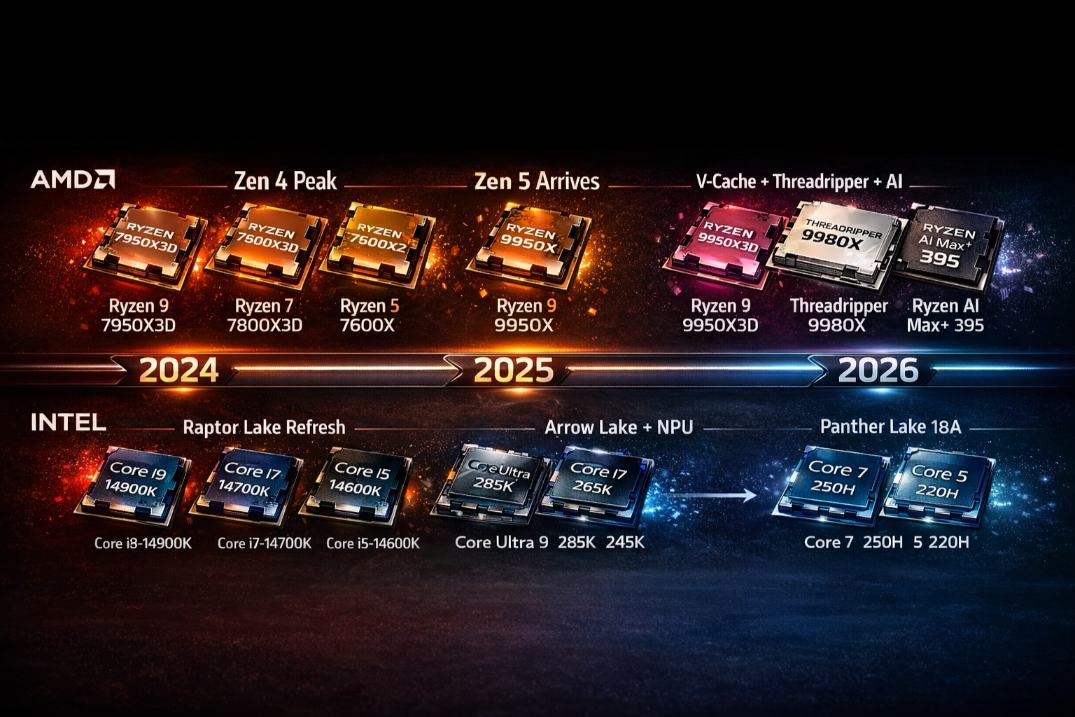
The processor market moves fast. Here are the key AMD and Intel CPUs from the last three years that remain relevant, with links to their real benchmark data on FPSBench.
AMD — Key Models by Year
2026 (Zen 5 3D V-Cache / Threadripper 9000 / Ryzen AI):
- AMD Ryzen 9 9950X3D — 16-core with 3D V-Cache, the ultimate hybrid for gaming and productivity
- AMD Ryzen 9 9900X3D — 12-core 3D V-Cache, strong all-rounder
- AMD Ryzen Threadripper 9980X — 64-core workstation monster
- AMD Ryzen Threadripper 9960X — 24-core entry Threadripper
- AMD Ryzen AI Max+ 395 — Mobile powerhouse with integrated RDNA 3.5 graphics
- AMD Ryzen AI 9 HX 370 — Premium AI-accelerated laptop processor
2025 (Zen 5 desktop launch):
- AMD Ryzen 9 9950X — 16-core Zen 5 flagship, rendering and development powerhouse
- AMD Ryzen 9 9900X — 12-core high-end, strong multi-threaded value
- AMD Ryzen 7 9800X3D — Gaming king with 3D V-Cache on Zen 5
- AMD Ryzen 7 9700X — 8-core mid-range, excellent all-around value
- AMD Ryzen 5 9600X — 6-core budget champion on AM5
- AMD Ryzen 5 9600 — Non-X variant, even better value
2024 (Zen 4 3D V-Cache peak / Zen 4 mature):
- AMD Ryzen 9 7950X3D — 16-core with V-Cache, still a top-tier hybrid chip
- AMD Ryzen 9 7950X — 16-core Zen 4, great value as prices drop
- AMD Ryzen 7 7800X3D — The gaming favorite of 2024, still excellent
- AMD Ryzen 7 7700X — Solid 8-core Zen 4 at reduced prices
- AMD Ryzen 5 7600X — Budget Zen 4, outstanding price-performance
- AMD Ryzen 5 7600 — Entry-level AM5, still very capable in 2026
Intel — Key Models by Year
2026 (Panther Lake mobile / Arrow Lake Refresh):
- Intel Core 7 250H — Panther Lake mobile, built on Intel 18A process
- Intel Core 7 240H — Panther Lake mid-range mobile with Xe3 graphics
- Intel Core 5 220H — Panther Lake mainstream mobile
- Intel Core Ultra 7 270K Plus — Arrow Lake Refresh desktop (launched March 2026, not yet in FPSBench database)
2025 (Arrow Lake desktop / Arrow Lake-H mobile):
- Intel Core Ultra 9 285K — Arrow Lake flagship, 24 cores with NPU
- Intel Core Ultra 7 265K — 20-core sweet spot with AI acceleration
- Intel Core Ultra 5 245K — Mid-range Arrow Lake desktop
- Intel Core Ultra 5 245KF — Same chip without integrated graphics, lower price
- Intel Core Ultra 5 225F — Budget Arrow Lake desktop
- Intel Core Ultra 9 285HX — Arrow Lake mobile flagship
2024 (Raptor Lake Refresh mature / Arrow Lake launch):
- Intel Core i9-14900KS — Raptor Lake's fastest, 6.2 GHz boost
- Intel Core i9-14900K — 24-core Raptor Lake flagship, still powerful
- Intel Core i7-14700K — 20-core value king of its generation
- Intel Core i5-14600K — Budget gaming and productivity staple
- Intel Core i5-14400F — Entry-level 14th gen, strong budget pick
Compare any of these processors head-to-head on FPSBench's comparison tool to see exactly how generational improvements translate into real performance gains.
How to Validate Any CPU Choice
No matter which processor catches your eye, we strongly recommend verifying its real-world performance before purchasing. Here is the workflow we use at PyroCPU:
- Look up the CPU on the FPSBench CPU database for detailed specs and benchmark scores
- Run a head-to-head comparison against the closest alternative
- Check the CPU rankings to understand where it sits in the overall hierarchy
- Review the price-performance data to confirm you are getting good value
- If gaming matters, check the games database for FPS data with your planned GPU pairing
- Use Rate My PC to validate that your CPU and GPU are well-matched
This data-driven approach eliminates guesswork and ensures every dollar of your hardware budget is well spent.
For more processor recommendations, technology coverage, and buying guides, visit PyroCPU.com. Browse our technology articles and computer hardware section for the latest.
All benchmark data referenced in this article can be verified on FPSBench.com — the comprehensive hardware performance database with real-world CPU benchmarks, GPU comparisons, and gaming FPS data.