
Why FPSBench.com Is the CPU Resource Serious Hardware Enthusiasts Have Been Waiting For
Published on PyroCPU.com — Your source for processor news, reviews, and analysis
Meta Title: Why FPSBench.com Is the Best CPU Benchmark & Comparison Resource in 2026 | PyroCPU
Meta Description: FPSBench.com delivers real-world CPU benchmarks, head-to-head comparisons, gaming FPS data, and price-performance rankings. Here's why it's the go-to resource for processor research in 2026.
Focus Keyword: CPU benchmarks and comparisons
Secondary Keywords: processor benchmark database, CPU performance rankings, real-world FPS data, CPU comparison tool, gaming CPU benchmarks
Processor research in 2026 is a mess. You open ten browser tabs, each showing different benchmark numbers from different reviewers using different test methodologies. One site says the Ryzen 9 9950X destroys the Core Ultra 9 285K. Another says the opposite. A third shows numbers that do not match either of the first two. By the time you have spent an hour cross-referencing conflicting data, you are no closer to a purchasing decision than when you started.
The root of the problem is fragmentation. CPU performance data is scattered across dozens of publications, YouTube channels, and forum threads, each with its own testing methodology, its own hardware configurations, and its own editorial biases. What the processor market has needed for years is a single, comprehensive, vendor-neutral database where every CPU is measured against the same yardstick — and where that data is organized into tools that actually help you make decisions.
That resource exists. It is called FPSBench.com, and after spending considerable time with the platform, we can say confidently that it is the most complete CPU research tool available to enthusiasts, builders, and professionals in 2026.
A CPU Database That Actually Covers Everything
The first thing that stands out about FPSBench is scope. The CPU Benchmarks page is not a curated list of the latest flagship processors with everything else ignored. It is a comprehensive database spanning AMD and Intel's entire modern lineup — desktop, laptop, workstation, and server processors alike.
You will find AMD's Zen 5 Ryzen 9000 series desktop chips like the Ryzen 9 9950X and the gaming-dominant Ryzen 7 9800X3D sitting alongside Intel's Arrow Lake Core Ultra 200S processors such as the Core Ultra 9 285K and Core Ultra 7 265K. But the database does not stop at current-gen flagships.
Scroll further and you will find previous-generation favorites that remain relevant — the Ryzen 7 7800X3D that dominated gaming through 2024, the Core i9-14900K that was Intel's Raptor Lake flagship, and budget workhorses like the Ryzen 5 7600 that still deliver excellent value. The database also covers Threadripper workstation parts, Xeon server CPUs, AMD's new Ryzen AI mobile processors, Intel's Panther Lake mobile chips, and even older-generation processors that matter for budget builders and upgraders.
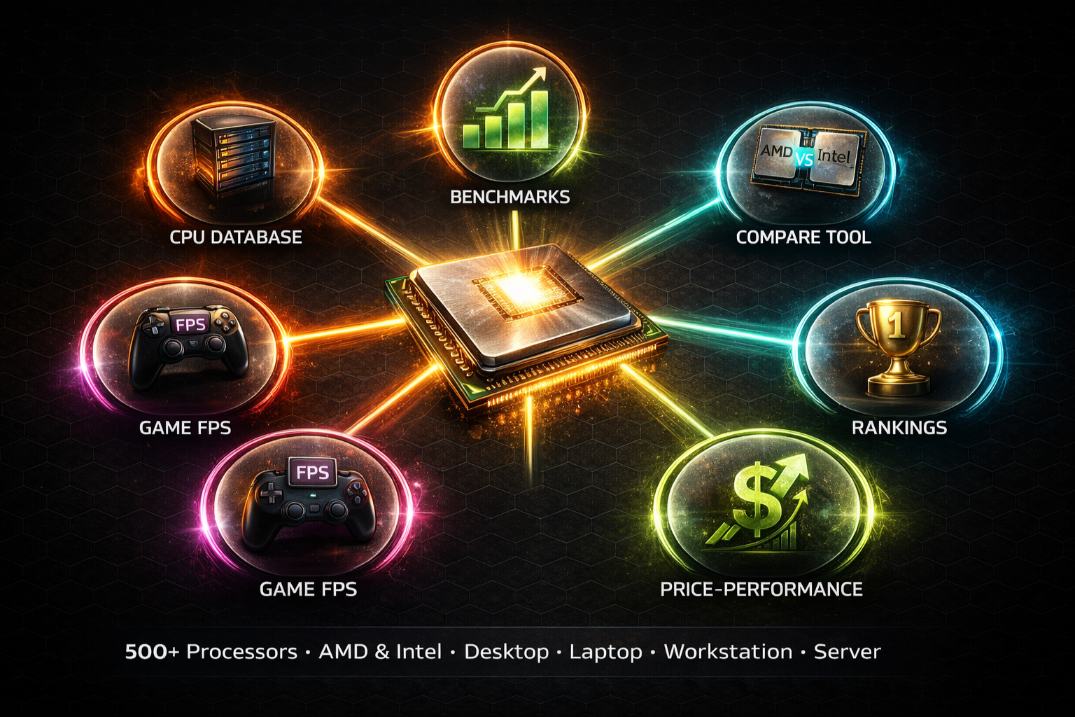
For those of us at PyroCPU who spend our days analyzing processor architectures and performance characteristics, having this breadth of coverage in a single searchable interface is a significant time-saver. Instead of hunting through archived reviews to find benchmark data on a two-year-old processor, you can pull it up in seconds. If you are curious about how we approach CPU technology coverage here at PyroCPU, the kind of raw data FPSBench provides is exactly what feeds that deeper analysis.
Benchmark Data You Can Actually Trust
The benchmark scores on FPSBench come from established testing suites — Passmark, Geekbench, Cinebench, and others — providing multiple data points for each processor rather than relying on a single synthetic score. This multi-source approach matters because different benchmarks stress different aspects of CPU performance.
Cinebench R23 is excellent for measuring sustained multi-threaded rendering throughput. Geekbench 6 provides a balanced view of single-core and multi-core performance across mixed workloads. Passmark covers a broader range of computational tasks. By presenting scores from all of these sources, FPSBench gives you a more complete picture of how a processor actually performs across different types of work.
Each CPU detail page presents these benchmarks with contextual data — showing where the processor ranks relative to others in the database, what percentile it falls into, and how it compares to its direct competitors. This context transforms raw numbers into actionable information. A Cinebench score of 15,000 means nothing in isolation. A Cinebench score of 15,000 that places a chip in the 85th percentile of all tested processors and 12% ahead of its closest competitor — that tells you something useful.
This is the kind of data-driven approach we advocate in our computer hardware coverage here on PyroCPU. Numbers without context are just noise. FPSBench understands this and builds context into every data presentation.
Head-to-Head CPU Comparisons That Settle Debates
Every hardware forum, every Reddit thread, every comment section is full of "X vs Y" processor debates. Ryzen 7 9800X3D vs Core Ultra 9 285K. Ryzen 9 9950X vs Core i9-14900KS. Ryzen 5 9600X vs Core Ultra 5 245K. These arguments go in circles because people are comparing numbers from different reviews conducted under different conditions.
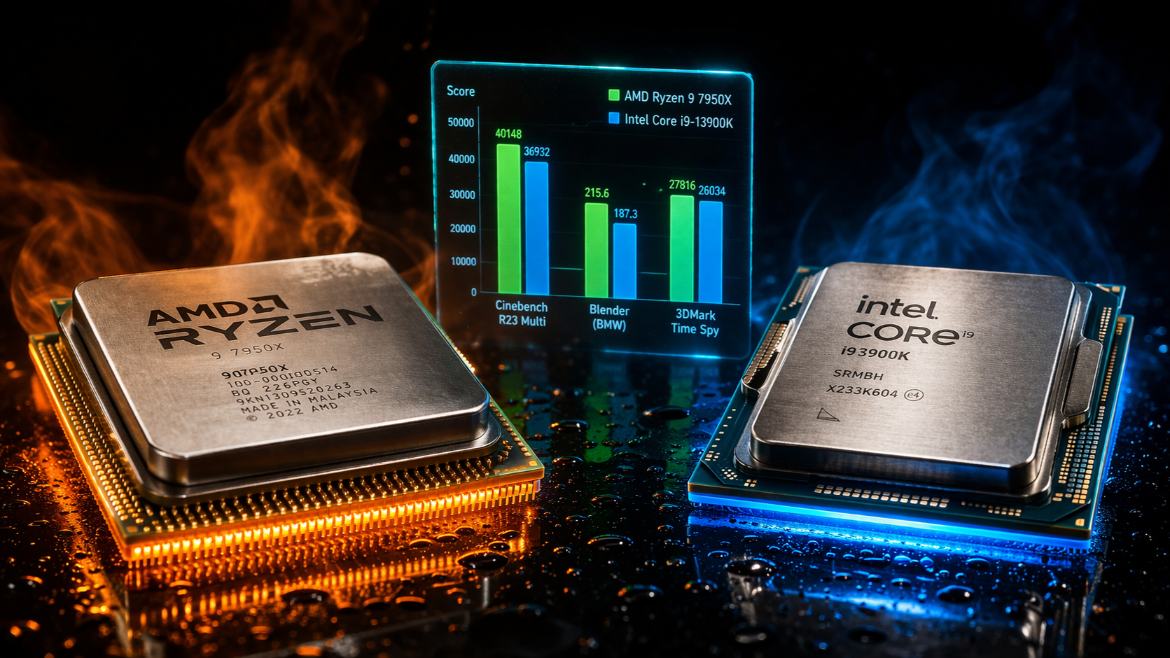
The CPU comparison tool on FPSBench eliminates this problem entirely. Select any two processors from the database, and you get a standardized side-by-side breakdown covering specifications, benchmark scores across every available test, and percentage differences for each metric. Same methodology, same scoring system, same conditions. The comparison speaks for itself.
This is not a gimmick feature. It is genuinely one of the most useful tools on the platform. When a reader asks us at PyroCPU whether they should go AMD or Intel for their next build, we can point them to a direct comparison on FPSBench and let the data answer the question. No editorial spin, no brand loyalty, just numbers.
The comparison tool also handles cross-generational matchups cleanly. Wondering how your existing Ryzen 7 5800X3D holds up against the newer Ryzen 7 9800X3D? Or whether upgrading from a Core i7-14700K to Arrow Lake's Core Ultra 7 265K is worth the cost? These are the kinds of practical questions that the comparison tool answers in seconds.
CPU Performance Rankings: The Full Hierarchy
Beyond individual comparisons, FPSBench provides comprehensive CPU performance rankings that show every processor in the database ranked by aggregate benchmark performance. This is the bird's-eye view that helps you understand where any given chip sits in the overall landscape.
The rankings page is particularly valuable for two scenarios. First, when you are starting a build from scratch and want to understand the full spectrum of options at different performance tiers. Second, when you want to evaluate how your current processor compares to the broader market — useful for deciding whether an upgrade is justified.
The hierarchy is presented clearly, with desktop and laptop processors separated so you are comparing like with like. You can see at a glance which processors occupy the top tier, where the mid-range sweet spots are, and which budget options punch above their weight. For anyone who follows our technology coverage here on PyroCPU, the FPSBench rankings provide the underlying data that informs those recommendations.
Price-Performance: Finding the Real Value
Raw performance rankings tell you which processor is fastest. CPU price-performance rankings tell you which processor is smartest to buy. These are very different questions, and FPSBench addresses both.
The price-performance analysis cross-references benchmark scores with current pricing to calculate a performance-per-dollar metric for every processor in the database. The results frequently challenge conventional wisdom. The flagship chip that dominates the performance rankings often delivers the worst value per dollar. The mid-range processor that nobody talks about might offer 85% of the flagship's performance at 40% of the price.
For budget-conscious builders — which, let us be honest, includes most of us — this is the most actionable page on the entire platform. It cuts through the marketing noise and answers the question that actually matters: where does my money go furthest?
This kind of value analysis is something we discuss regularly in our computer hardware guides at PyroCPU. Having a continuously updated price-performance database to reference makes those recommendations far more grounded in current market reality.
The Game FPS Data: Where FPSBench Truly Shines
Everything we have discussed so far — specifications, synthetic benchmarks, rankings, comparisons — is available in various forms across the web. Where FPSBench pulls decisively ahead of every other CPU resource is its real-world gaming FPS data.
The games database contains measured frame rate data for specific CPU and GPU combinations in specific games at specific resolutions and quality settings. This is not estimated performance. This is not theoretical throughput calculated from clock speeds and IPC numbers. This is actual FPS data from actual hardware running actual games.
Why does this matter for a CPU-focused audience? Because CPU performance in games is notoriously difficult to predict from synthetic benchmarks alone. A processor's Cinebench score tells you almost nothing about how it will perform in a CPU-limited scenario in Starfield or Cities: Skylines II. Cache size, memory latency, branch prediction accuracy, and single-threaded IPC all interact in complex ways that only real-world testing can reveal.
This is exactly why AMD's 3D V-Cache processors — from the original Ryzen 7 5800X3D through the Ryzen 7 7800X3D to the current Ryzen 7 9800X3D — dominate gaming benchmarks despite having lower clock speeds than their non-X3D counterparts. The massive L3 cache reduces memory latency in ways that synthetic benchmarks do not capture but that game engines absolutely benefit from. FPSBench's game FPS data reveals these real-world advantages clearly.
For our readers who follow PyroCPU's performance optimization guides, the FPSBench games database is an essential companion resource. We analyze the architectural reasons behind performance differences; FPSBench provides the measured data that confirms or challenges those analyses.
Tools That Turn Data Into Decisions
Raw data is only useful if you can act on it. FPSBench wraps its database in several purpose-built tools that transform benchmark numbers into practical answers.
The Rate My PC tool evaluates your specific CPU and GPU combination against the entire hardware database. It tells you where your system ranks overall, whether your components are well-matched or bottlenecked, and how your build compares to the broader market. For CPU enthusiasts, the bottleneck analysis is particularly valuable — it identifies whether your processor is holding back your GPU or vice versa, which directly informs upgrade decisions.
The Can I Run It tool takes a specific game and your hardware combination and returns real FPS estimates based on actual benchmark data. Unlike the vague minimum and recommended specifications that game developers publish, this tool gives you concrete frame rate numbers. If you are wondering whether your Ryzen 5 7600X can handle the latest AAA title at 1440p, this tool provides the answer with actual data rather than guesswork.
The What Games Can I Run tool inverts the question — start with your hardware and discover which games will run well on your system. This is especially useful for budget builders who want to know exactly what their hardware investment will deliver across a library of titles.
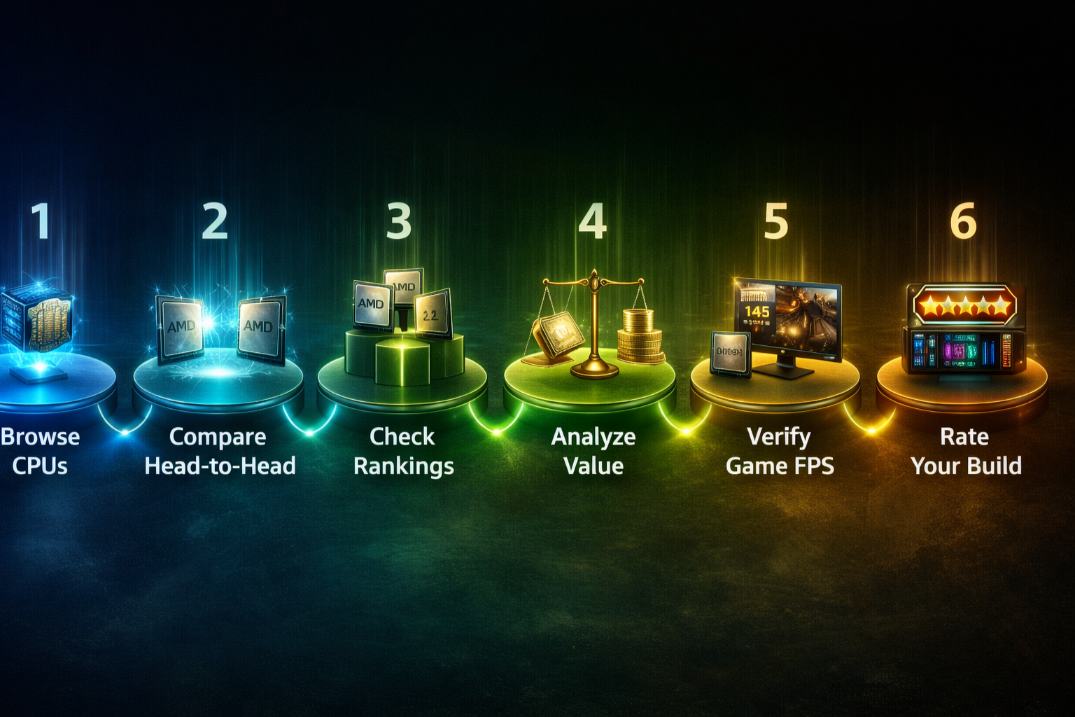
These tools represent the practical payoff of FPSBench's comprehensive data collection. The database is the foundation; the tools are how that foundation becomes useful for real purchasing and upgrade decisions.
Why This Matters for the CPU Enthusiast Community
At PyroCPU, we have always believed that the processor is the heart of any computing system. It determines not just raw performance but the character of the entire user experience — how responsive the system feels, how well it multitasks, how future-proof the platform will be. Choosing the right CPU is arguably the most important decision in any build.
That decision deserves better than fragmented data, conflicting reviews, and marketing spin. It deserves a comprehensive, vendor-neutral resource that presents real performance data in a format designed for comparison and decision-making.
FPSBench delivers exactly that. The CPU database provides the breadth. The benchmark data provides the depth. The comparison, ranking, and price-performance tools provide the analytical framework. And the game FPS data provides the real-world validation that no synthetic benchmark can match.
Whether you are building a new system from scratch, evaluating an upgrade path, or simply trying to understand where your current processor sits in the 2026 landscape, FPSBench is the resource that makes informed decisions possible. We have added it to our recommended tools list at PyroCPU, and we suggest you bookmark it too.
The Competitive Landscape: How FPSBench Compares
It is worth acknowledging that other hardware databases exist. UserBenchmark has been around for years but has faced persistent criticism for questionable benchmark weighting that appears to favor certain manufacturers. PassMark's own website provides benchmark data but lacks the gaming FPS integration and comparison tools that make FPSBench practical for real-world decision-making. Sites like Tom's Hardware and AnandTech (now archived) provide excellent editorial reviews but cover only a fraction of available hardware.
FPSBench occupies a unique position by combining the breadth of a comprehensive database with the depth of real-world gaming data and the practicality of purpose-built decision tools. It is not trying to replace editorial reviews — it is providing the data layer that makes those reviews more useful.
For the CPU enthusiast community, this combination of comprehensive data, practical tools, and vendor-neutral presentation makes FPSBench.com an indispensable resource. The processor market in 2026 is more competitive and more complex than ever. Having a single platform where you can research, compare, rank, and validate any CPU purchase is not just convenient — it is essential.
For more processor analysis, reviews, and buying guides, visit PyroCPU.com. Browse our computer hardware articles for coverage of new processor technology, overclocking guides, and performance tips.
Explore the full FPSBench CPU ecosystem: CPU Benchmarks · CPU Rankings · CPU Price-Performance · CPU Comparisons · Game FPS Data · Rate My PC · Can I Run It · What Games Can I Run